It’s been a while. 🙂 My life in the past year was quite eventful, and updating the blog wasn’t on the top of my mind, but now I’m back to my usual routine and it’s worth sharing what I’ve been up to.
Among other changes, since this summer I’m back at JetBrains in a part-time role. I’d made an honest attempt to separate myself from the company and to build a new identity for myself as a linguist, not a software developer, but it turned out to be harder than I had expected. Age differences, somewhat unconventional research interests on the intersection of linguistics and software, and my overall difficulties in networking all played a role in that. And on the other hand, I still cared a lot about the things going on at the company and the people there, so coming back felt really easy and natural. The only challenge was finding a role where I could take a meaningful chunk of responsibility with a part-time engagement, but all in all I do feel that I’m making a valuable contribution.
My studies at Leiden University are going on as planned. I completed my pre-master program in June and got accepted into the two-year Research Master in Linguistics program with a focus on comparative Indo-European studies. The first semester felt very intense but really fulfilling: at last I’m getting the knowledge for which I came to Leiden, and seeing different pieces of the Proto-Indo-European puzzle come together from the different courses is a great feeling. Also, all the courses in the first semester were taught by the core group of the Indo-European professors in Leiden, which is not always the case, and it definitely felt like we were getting the knowledge straight from the source.
The courses I took in the first semester were Indo-European phonology and nominal morphology, Ancient Greek, Vedic Sanskrit, Mycenaean and Homeric Greek, and advanced Indo-European verbal morphology.

Ancient Greek used to be a two-semester course, but now, due to budget constraints, it was compressed to a single semester, with 4 hours of classes each week. Learning the entire grammar of the language, along with a bunch of details on historical phonology, in a single semester was quite demanding, and it helped a lot that I haven’t forgotten everything from my four years of Ancient Greek in the gymnasium back in St.Petersburg.
For Sanskrit, we also had 4 hours a week, and a much more modest learning goal: to be able to make sense of Sanskrit examples in articles on Indo-European linguistics. I don’t know if the difficulty lies with the language or the way it was taught, but I feel I haven’t learned nearly as much compared to Greek. An additional challege was having to write a paper. When you barely know a language and others have studied it for a couple hundred years, and you haven’t been exposed to any scholarship, even finding a good topic is hard enough. I managed to find something in an area that I understand (historical phonology) where there’s controversy in the literature, and ended up writing about the development of voiced fricatives. (The sounds z and zh existed in Proto-Indo-Iranian, the common ancestor of Sanskrit and Avestan, and in Sanskrit they disappeared and sometimes caused the preceding vowel to change. Scholars disagree on which vowel changes are the standard development, and which are exceptional.) The grades are not yet in, so I don’t know if my paper is any good.
Mycenaean and Homeric Greek was a lot of fun. We got an introduction to Mycenaen Greek and a tour of active research in the area, highlighting the connections between the world described in the Mycenaean tablets and Homeric poems. I really enjoyed writing my paper for this class, analyzing the uses of the particle –qe (cognate of the Latin –que), which normally has the meaning “and”, but in some cases requires a different interpretation. The effort paid off: I have a good grade and very positive feedback from the professor.
Advanced Indo-European verbal morphology was a bit out of place for me: the way the program is structured is that this course is offered every two years in the first semester, whereas the basic verbal morphology is taught in the second semester. This means that there was no way for me to learn the basic material before the advanced topics. I was able to catch up on the basics myself, but now I’m not sure if there’s enough for me to do in the basic course, which I’m taking now,. My paper for the course was on the origin of the Latin second person plural endng –mini. The accepted theory connects it to the participle ending -menos which is common in Greek but appears only in a couple words in Latin. Unfortunately there’s very little evidence for or against the theory, and my main contribution in the paper was demonstrating why a part of it isn’t even valid.
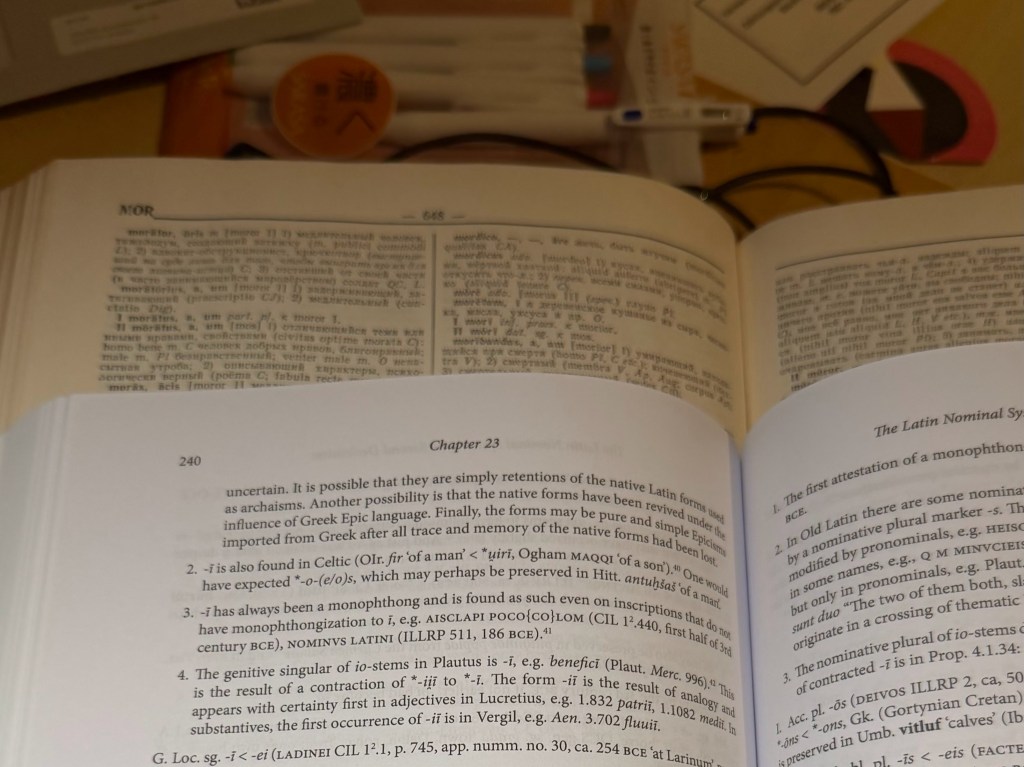
Besides my regular studies, I also attended the Leiden summer school (for the third time already) and the LOT winter school this January, but the post is long enough as it is, so I won’t go into the details about the courses I took there.
In other news, I’m still abstaining from the use of AI for research, writing or personal needs. I’m starting to explore the use of AI agents for coding, because it’s necessary for my current position at JetBrains (we even recorded a video of me trying it out for the first time). I also believe that Etymograph needs to exist and I can get it done faster with the help of agents. I care a lot about its linguistic core, but there’s also a lot of infrastructure work that needs to be done to make it usable by others, and the “weighed average of all of GitHub”, which is what AI agents can build for you, will be a perfectly fine approach to that work.
Outside of coding, I sometimes look at Google AI overviews (because they’re really in your face and I’m too lazy to add “fucking” to every search query to ensure they’re not shown), and I begrudgingly let my partner show or read ChatGPT output to me once in a while. Otherwise, I’m watching from the sidelines – I read a lot about other people’s experience with AI, but never engage actively.
That’s all for now. The second semester is now underway, and I’ll share more updates as it goes.


 yole's journey in languages
Leave a comment